
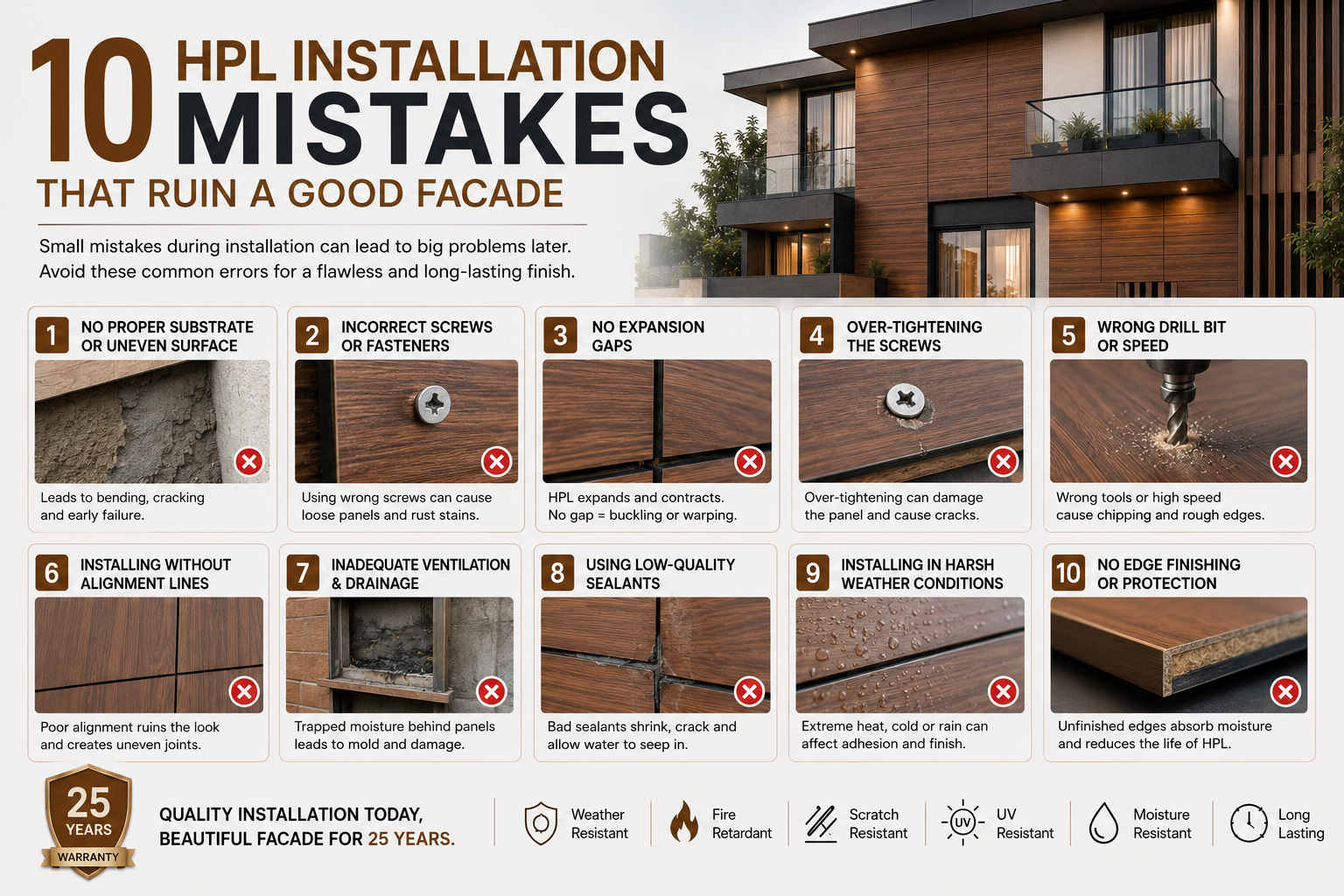
Quick answer: The most damaging HPL installation mistakes are rigid fixing without movement allowance, undersized or rusting sub-frames, sealed cavities, wrong support spacing, sharp-cornered cut-outs, mixed production batches on one elevation, and leaving the protective film on too long in the sun. All of them are avoidable at no extra cost.
Table of Contents
- Mistake 1: Fixing the Panel Rigidly
- Mistake 2: An Undersized or Rusting Sub-Frame
- Mistake 3: Sealing the Ventilated Cavity
- Mistake 4: Wrong Support Spacing for the Thickness
- Mistake 5: Sharp-Cornered Cut-Outs
- Mistake 6: Mixing Production Batches on One Elevation
- Mistake 7: Leaving the Protective Film on Too Long
- Mistake 8, 9 and 10: The Quiet Ones
- The Pattern Behind All Ten
- Frequently Asked Questions
Mistake 1: Fixing the Panel Rigidly
HPL expands and contracts with temperature and humidity. Pin it tightly at every hole and it has nowhere to go, so it bows outward in summer and stresses the fixings in winter. Over a few cycles the rivet holes elongate or the panel cracks from the hole outwards.
One fixed point per panel. Every other hole oversized. This single rule prevents more facade complaints than any other.
Mistake 2: An Undersized or Rusting Sub-Frame
The panel is rarely the weak link. Thin aluminium sections chosen to save money flex under wind load, which transfers into the panels as visible ripple. Worse, untreated mild steel framing in a coastal or humid city rusts within a couple of years, staining the panel faces from behind and losing anchorage.
- Size the sub-frame for the calculated wind load at the building’s height and location, not by habit.
- Use aluminium or properly galvanised and treated steel.
- Check bracket anchors are rated for the substrate – hollow block needs different fixings from RCC.
Mistake 3: Sealing the Ventilated Cavity
Somebody decides that an open gap at the base of the facade looks unfinished, and seals it. The cavity now cannot drain or ventilate, humid air is trapped against the wall, and the entire thermal and drying benefit of a rainscreen is lost. Use insect mesh, never a solid closer.
Mistake 4: Wrong Support Spacing for the Thickness
A 6mm panel on a grid designed for 8mm will visibly deflect between supports. This usually happens when a project value-engineers the panel thickness down after the frame layout is already fixed. If the thickness changes, the grid must change with it.
Mistake 5: Sharp-Cornered Cut-Outs
Every cut-out for a light fitting, vent or downpipe is a potential crack origin. A 90-degree internal corner concentrates stress precisely where the panel is weakest. Always drill a radius at internal corners and cut to the hole, and keep cut-outs away from panel edges wherever the design allows.
Mistake 6: Mixing Production Batches on One Elevation
Shades are pressed in batches and small variation between batches is normal and acceptable. What is not acceptable is discovering it after installation, when two panels in the middle of a wall read slightly different in afternoon light. Order the full elevation in one lot, confirm batch numbers on delivery, and keep spare panels from the same batch.
Mistake 7: Leaving the Protective Film on Too Long
The film is there for transport and handling, not for the life of the building. Left on a sun-facing elevation for weeks, the adhesive bakes and leaves residue that is difficult to remove without aggressive solvents, which then damage the surface. Remove it within the manufacturer’s stated period after fixing.
Mistake 8, 9 and 10: The Quiet Ones
| Mistake | What it causes | Prevention |
|---|---|---|
| Over-tightened rivets | Panel is locked and cracks around the hole | Use the correct rivet gun setting and spacer heads |
| Storing panels leaning in the sun | Permanent bow before installation even starts | Stack flat, covered, off the ground, indoors |
| Cleaning with abrasives or solvents | Permanent surface dulling, voided warranty | Mild detergent, soft cloth, follow the care sheet |
The Pattern Behind All Ten
Look at the list and one theme runs through it: the panel is treated as a finish rather than as part of an engineered system. HPL is a high-performance material with predictable behaviour – it moves, it needs air behind it, it needs support at the right spacing, and it needs to be handled like a finished surface from the day it lands on site.
Get those four things right and an HPL facade will look the same in year fifteen as it did in week one. That is exactly why HPL Maker backs its exterior sheets with a live camera warranty of up to 25 years, and why our team reviews the fixing details before dispatch rather than after a complaint.
Key Takeaways
- Allow the panel to move – one fixed point, oversized holes everywhere else.
- Size the sub-frame for wind load and use corrosion-resistant material.
- Never seal the ventilated cavity; use insect mesh instead.
- Match support spacing to the actual panel thickness supplied.
- Radius every internal corner of a cut-out and keep one production batch per elevation.
Frequently Asked Questions
Why are my HPL panels bowing?
The most common cause is rigid fixing that prevents thermal movement, followed by support spacing that is too wide for the panel thickness, and panels stored leaning in the sun before installation. Oversized fixing holes and a single fixed point per panel usually prevent it.
Why did my HPL panel crack near a rivet?
Cracks radiating from a fixing hole almost always mean the hole was not oversized, the rivet was over-tightened, or both. The panel expanded, could not move, and released the stress at its weakest point.
Can two HPL panels from different batches look different?
Yes, slightly. Decorative laminates are pressed in batches and minor shade variation between batches is normal. Order one elevation in a single lot and keep spare panels from the same batch for future repairs.
How long can protective film stay on HPL?
Follow the manufacturer’s stated period, which is generally a matter of weeks, and remove it sooner on sun-exposed elevations. Baked-on film adhesive is difficult to remove without aggressive solvents that can damage the surface.
Who is responsible if an HPL facade fails?
It depends on the cause. Material defects sit with the manufacturer, while fixing errors, sub-frame design and cavity detailing sit with the installer or facade contractor. This is why written installation guidelines and a documented warranty scope matter before work starts.
Related Reading on HPL Maker
Talk to HPL Maker
HPL Maker is an Indian manufacturer of exterior-grade high pressure laminate with an industry-first live camera warranty of up to 25 years. Share your drawings or elevation photos and our team will suggest the right shade, thickness and fixing system for your project.
- Call / WhatsApp: +91 89824 90236
- Email: marketing@hplmaker.com
- Factory & Head Office: 124-126, Vrindavan Palace, Nipania Main Road, Vijay Nagar, Indore – 452010, Madhya Pradesh, India